Earn $80K in Canada? How Much Mortgage Can You Actually Get?
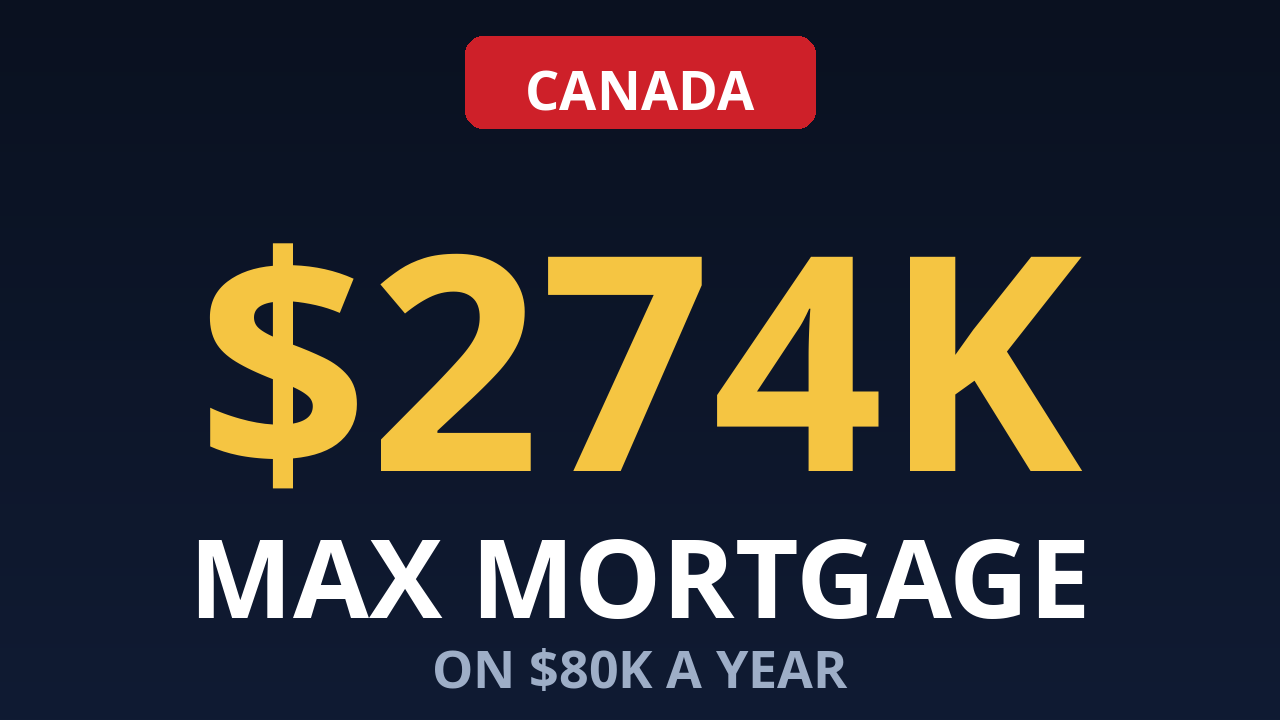
On an $80,000 salary in Canada, the stress test caps your maximum mortgage at $273,952 — not the $331,575 you could borrow without it. After property tax and heating, your payment room is $1,833 a month. The comfortable loan on this salary is $204,219 — enough for a home around $255,273.

Earn $80,000 a year in Canada and the house math feels simple — until the stress test runs. This is the full written version of Money Made Simple's Canadian Salary Ladder, episode 1: "Earn $80K in Canada? Your Max Mortgage Is $274K." Every figure below was computed in the episode's own calculator sheet (assumptions dated 2026-11-05), not guessed — and you can check each step yourself.
Key takeaways
- On an $80,000 salary, the bank's maximum mortgage in this worked example is $273,952 — not the $331,575 the same payment room would carry without the stress test.
- The stress test costs this salary $57,623 of borrowing power: you must qualify at 6.49% (the example contract rate of 4.49% + 2%), even though you pay at 4.49%.
- Two ceilings decide everything: housing costs under 35% of gross income (GDS) and housing plus all debts under 42% (TDS).
- Property tax and heating eat $500 of the monthly room before the mortgage gets a dollar — the real payment room is $1,833.33 a month.
- The bank's maximum is a ceiling, not a target: the episode's comfort number is $204,219, a home around $255,273 with 20% down.
🎁 Free companion for this guide
The free Money Pack pairs with this guide — and Pai Ledger HQ puts it into practice, starting with a free trial.
Step 1: The $80K salary, monthly
Lenders do their math monthly, so start there. An $80,000 gross salary is $6,666.67 a month before tax. Every ceiling below is a percentage of that one number.
Step 2: Rule 1 — the 35% GDS ceiling
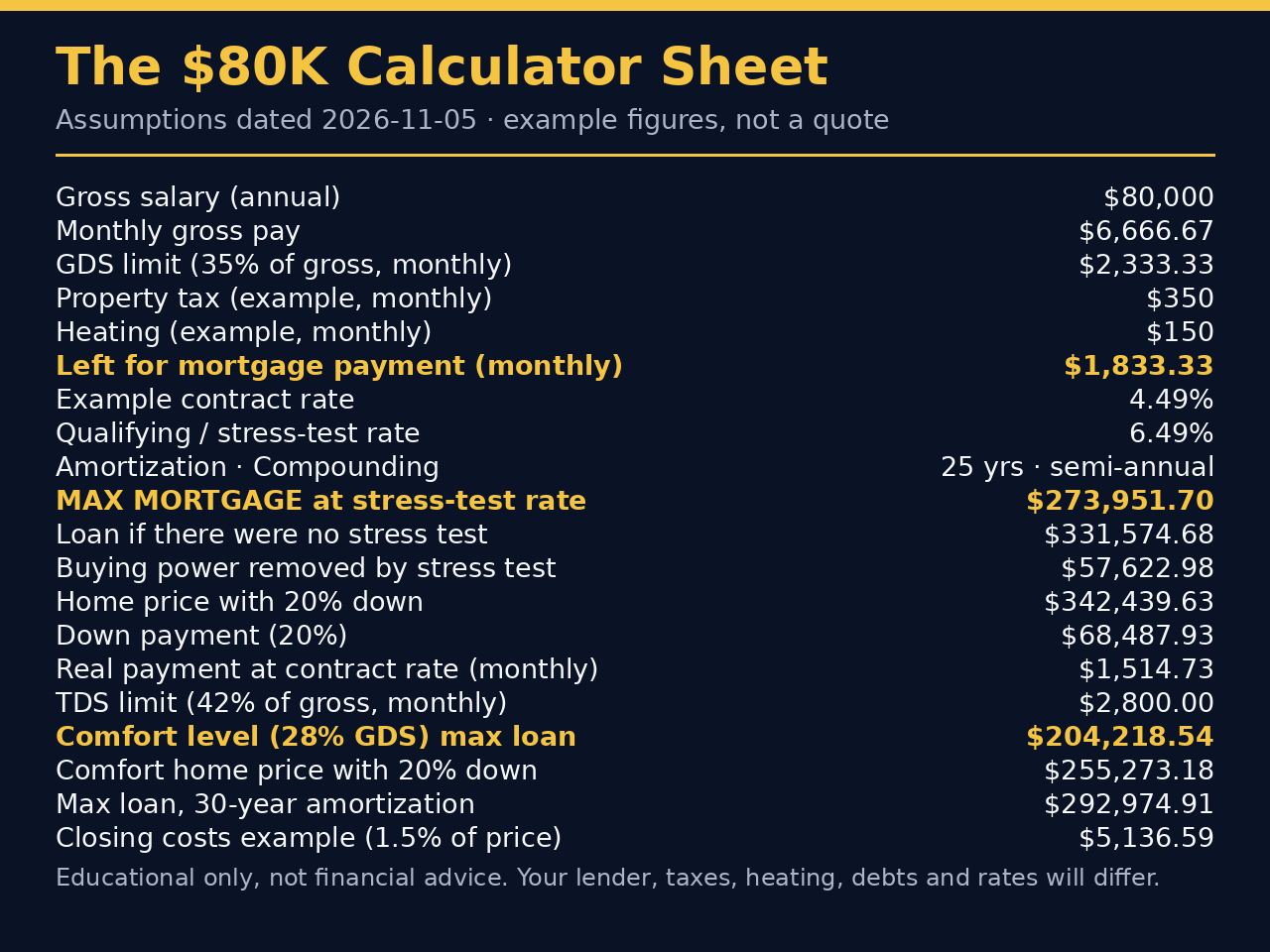
GDS (gross debt service) caps your total housing costs — mortgage payment, property tax and heating — at a share of your gross income. This episode's example uses a 35% GDS ceiling: 35% of $6,666.67 = $2,333.33 a month for all housing costs combined. That $2,333.33 is not your mortgage payment. Tax and heat get paid out of it first.
Step 3: Tax and heating eat $500 of it
The worked example uses $350 a month for property tax and $150 a month for heating — $500 gone before the mortgage payment: $2,333.33 − $500 = $1,833.33 a month left for the mortgage payment itself. This is the step most first-time buyers miss: your real payment room is $1,833, not $2,333.
Step 4: Rule 2 — the stress test at 6.49%
Canadian lenders must check that you could still carry the loan at a higher qualifying rate: your contract rate plus 2%, with a floor of 5.25% — whichever is higher. The example contract rate is 4.49%, so the test runs at 6.49%.
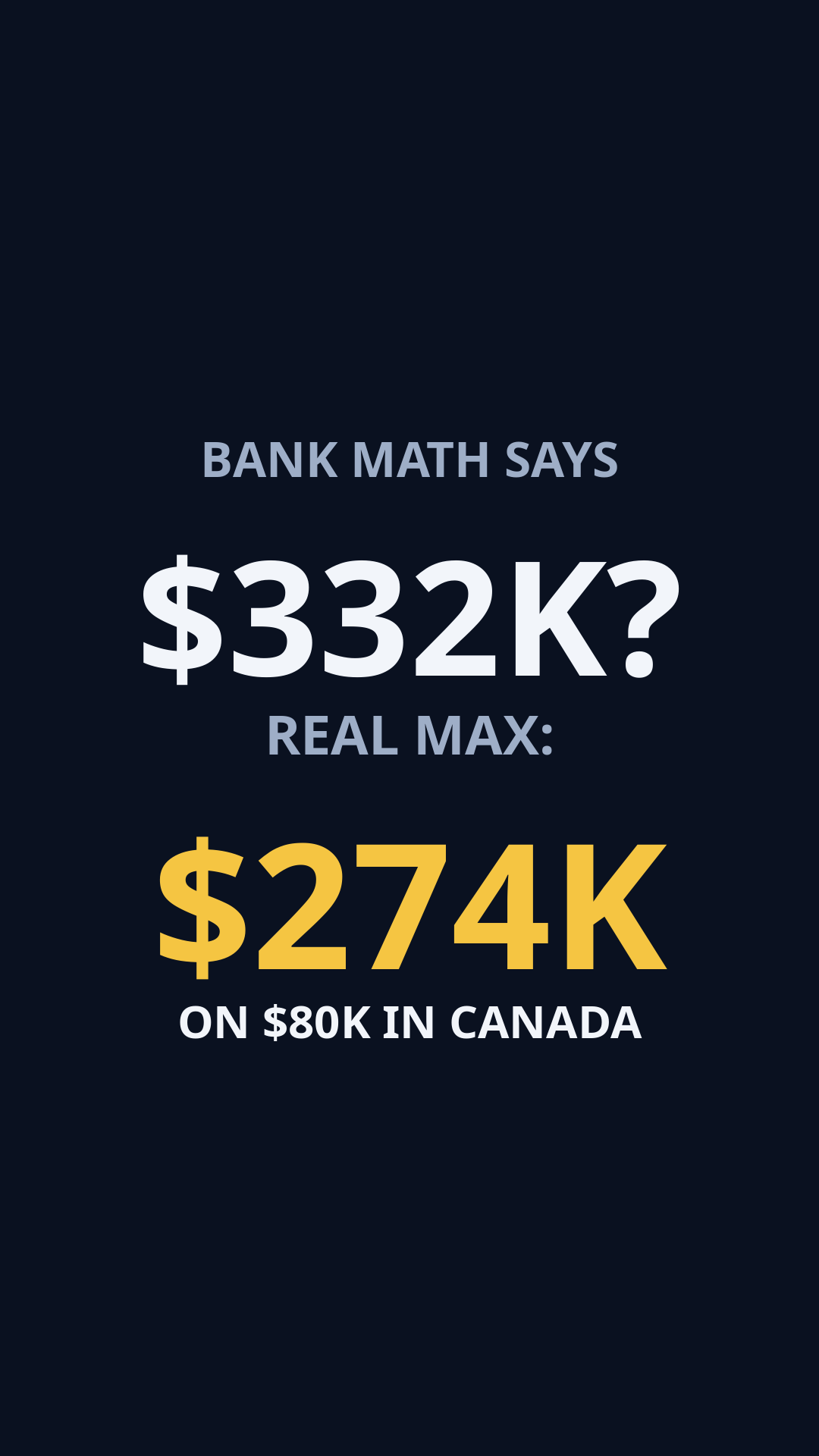
Same $1,833.33 of monthly room, two very different loans (25-year amortization, Canadian semi-annual compounding): at the 4.49% contract rate, that room would carry $331,575; at the 6.49% qualifying rate, it carries $273,952. The difference — $57,623 — is the borrowing power the stress test removes. You will pay at 4.49%, but the size of your loan is decided at 6.49%. That gap is the whole point of the episode: $274K is the real maximum, not $332K.
Why is this number different from our $100K guide?
Our Max Mortgage on $100K Income in Canada guide includes a $60K–$150K ladder that puts the $80K rung at about $328,000 — a different number for the same salary, because that guide uses different assumptions: a 39% GDS / 44% TDS ceiling, qualification at 6.25% (a 4.25% example contract rate + 2%), and $450 a month for property tax and heat. This post follows Salary Ladder episode 1 exactly: 35% GDS / 42% TDS, qualification at 6.49% (a 4.49% contract rate + 2%), and $500 a month for tax and heat ($350 + $150) — which gives $273,952. Both are internally correct worked examples; neither is a quote. Compare the assumptions, not just the headline, and run your own lender's numbers.
Put this into practice: Pai Ledger HQ
Pai Ledger HQ tracks your real payoff date as payments land, and the free Money Pack includes this episode's calculator sheet so you can run the same stress-test math on your own numbers.
Pai Ledger HQ is $6/mo, $61.20/yr or $120 lifetime — or get it inside the All Apps Pass ($72/mo) with every other app.
Step 5: Rule 3 — the 42% TDS debt check
TDS (total debt service) is the second ceiling: housing costs plus every other debt payment must stay under 42% of gross income: 42% of $6,666.67 = $2,800 a month for housing and all debts together.
In the worked example, GDS is the limit that bites first, so the maximum stays $273,952. But every dollar of car loan, card or student debt payments eats into the same room — the video walks through a TDS check with $300 a month of other debts to show how quickly the binding limit can switch from GDS to TDS. If your debts are large, TDS — not GDS — sets your real maximum.
Step 6: The home price — 20% down, plus closing costs
A $273,952 mortgage at 80% of the price means: maximum home price $342,440; down payment (20%) $68,488; closing costs to budget on top (1.5% of price in this example) about $5,137. The down payment is not the finish line — the closing costs cannot come out of the mortgage, so they need their own savings.
Step 7: What you actually pay each month
Here is the part that surprises people. You qualify at 6.49%, but you pay at your contract rate. On the maximum $273,952 loan at the example 4.49% contract rate, the real monthly payment is $1,514.73 — noticeably less than the $1,833.33 of room the test was built on. The stress test is a buffer, not your bill.
The comfort number: about $204K
The bank's maximum is a ceiling, not a target. The episode also runs a comfort level at 28% GDS — a loan that leaves room for repairs, savings and life: comfort loan $204,219; comfort home price with 20% down about $255,273. For many households on $80K, that smaller number is the one that actually fits.
A legal way to borrow more: 30 years
One lever genuinely moves the maximum: a longer amortization. For eligible buyers, stretching to a 30-year amortization raises the maximum loan in this example to $292,975 — same salary, same stress test, smaller monthly payment at the test rate. The trade-off is more interest over the life of the loan, so it is a lever, not a free upgrade.
Put it into practice
Pai Ledger HQ tracks your real payoff date as payments land, and the free Money Pack includes this episode's calculator sheet so you can run the same stress-test math on your own numbers.
Get the free Money Pack Pai Ledger HQ
Or get every Pai Digital app in one plan: the All Apps Pass — $72/mo, $734.40/yr or $1,440 lifetime, with free trials on every app.
Frequently asked questions
How much mortgage can I get on an $80,000 salary in Canada?
In this worked example, the maximum is $273,952. The assumptions: a 35% GDS ceiling, $350 a month of property tax and $150 a month of heating, a 25-year amortization, and qualification at 6.49% (an example contract rate of 4.49% + 2%). Your lender's number will differ with your real tax, heating, debts and rate.
What is the Canadian mortgage stress test?
Lenders must check you could still pay at your contract rate plus 2%, with a 5.25% floor — whichever is higher. In this example, a 4.49% contract rate is tested at 6.49%. You pay at your real rate, but your loan size is set by the higher test rate — here, the test removes $57,623 of borrowing power.
What are GDS and TDS ratios?
GDS (gross debt service) caps housing costs — mortgage payment, property tax and heating. This example uses 35% of gross income: $2,333.33 a month on an $80,000 salary. TDS (total debt service) caps housing plus all other debt payments at 42%: $2,800 a month. Whichever ceiling gives the smaller room is the one that decides your maximum.
What home price can I buy on $80K with 20% down?
With 20% down on the maximum mortgage in this example, about $342,440 — with a down payment of $68,488. Budget closing costs on top: about $5,137 in this example, at 1.5% of the price.
Should I borrow the maximum the bank offers?
The bank's maximum is a ceiling, not a target. At this episode's 28% GDS comfort level, the same salary carries about $204,219 — a home around $255,273 with 20% down, with room left for repairs, savings and life. Your actual payment on the maximum loan would be $1,514.73 a month at the example 4.49% contract rate.
Can a 30-year amortization get me a bigger mortgage?
Yes, for eligible buyers. Under the same example assumptions, a 30-year amortization raises the maximum loan to $292,975, because the payment at the stress-test rate is smaller. The trade-off is more total interest over the life of the loan.
How we make these guides
Every guide in this section started as a video on one of our YouTube channels, and the written version is checked against that video's own script before it is published. Account figures are stated with the year they apply to, drawn from the rules published by the CRA — and the worked examples use standard amortization math you can re-run yourself in our free mortgage calculator. We do not invent numbers: if a figure is not in the video or a source the guide names, it is not in the guide. When a rule changes, we update the guide — and the “last verified” date at the top of this page changes with it. Everything here is educational only — not financial, tax, legal or investment advice for your specific situation.
Recommended next reads
 Mortgage & Housing
FHSA Canada: The First Home Savings Account Explained (2026)
The FHSA combines an RRSP-style tax deduction with a TFSA-style tax-free withdrawal for first homes. $8,000 a year, $40,000 lifetime — the full 2026 guide.
 Mortgage & Housing
Mortgage Every Two Weeks: How Much Faster Do You Actually Pay It Off?
Canadian Money Math #11: accelerated bi-weekly vs monthly mortgage payments — the real interest saved, the years cut, and the trap in regular bi-weekly.
 Mortgage & Housing
Max Mortgage on $100K Income in Canada: $427K, Not $500K
On $100K of Canadian household income the max mortgage that passes the stress test is about $427K, not $500K. The $60K–$150K ladder, GDS 39% / TDS 44%, and the $46,000 two-bill trap.
Watch next
Prefer reading? Read the guide: FHSA Canada: The First Home Savings Account Explained (2026)
Disclaimer: This post is for education and information only and is not financial, mortgage, tax or legal advice. Figures are a worked example using the stated assumptions and example rates as of November 2026; they are not a quote, pre-approval or guarantee. Mortgage rules, rates and programs change — speak with a licensed Canadian mortgage professional about your own situation before making decisions.
💬 Over to you
Which ceiling would stop you first — the 35% GDS limit, the 42% TDS debt check, or the 6.49% stress-test rate? Run your own numbers on the free calculator sheet and tell us which one you hit.
Share it in the comments below — every comment gets a reply.
Comments
Comments are moderated to keep this page clean: first comments and anything containing a link are checked by a human before they appear, and spam is blocked automatically. Your email is never shown — it only tells the moderator you are a returning reader.
Loading comments…